How to Brief
a 3D Character Artist
- 846 Views
Let's be honest. Most creative briefs are terrible.
Not because clients are bad at their jobs — but because nobody tells you how to brief a 3D character artist specifically. You know what you want in your head. You've got a vibe. A reference image saved somewhere in a folder called "inspo" that you haven't opened in three weeks. Maybe a rough sketch on a napkin.
That's not a brief. That's a mood.
Here's the good news: writing a solid character brief isn't hard. It just requires knowing what information actually matters — and why. Get this right, and your project will move faster, look better, and cost less. Get it wrong, and you'll spend weeks in revision hell wondering why the character doesn't look like what you imagined.
The golden rule of briefing
A good brief takes one hour to write and saves three weeks of revisions. Every detail you include upfront is a round of feedback you'll never have to send.
1. Start With the "Why" — Not the "What"
This is where most briefs go wrong immediately. Clients lead with appearance — "I want a tall warrior with red armour" — without explaining why the character exists in the first place.
Before you describe a single piece of clothing or the colour of their eyes, answer these questions: Who is this character narratively? What do they need to communicate — power, approachability, menace, mystery? Who is the audience? A mascot for a children's brand and a boss enemy for a dark fantasy RPG are both characters — but they live in completely different design languages.
When you start with purpose, every design decision that follows has a reason. And characters with reasons behind them always look better than characters designed by committee from a Pinterest board.
2. References Are Not Optional — They're Non-Negotiable
"I'll know it when I see it" is not a brief. It's a horror story. Your artist cannot read your mind. What you imagine when you say "edgy" and what they imagine are probably two completely different things. References exist to close that gap — and they are the single most valuable thing you can put in a brief.
What to include
- Style references — visual language & feeling
- Silhouette — body type & proportions
- Clothing & armour direction
- Colour palette or swatch
- Mood references — emotional register
What doesn't count
- One Pinterest screenshot
- "Something like [vague movie]"
- A description with no visuals
- References from completely different styles
- "You'll figure it out"
3. Describe the Character — But Describe What Matters
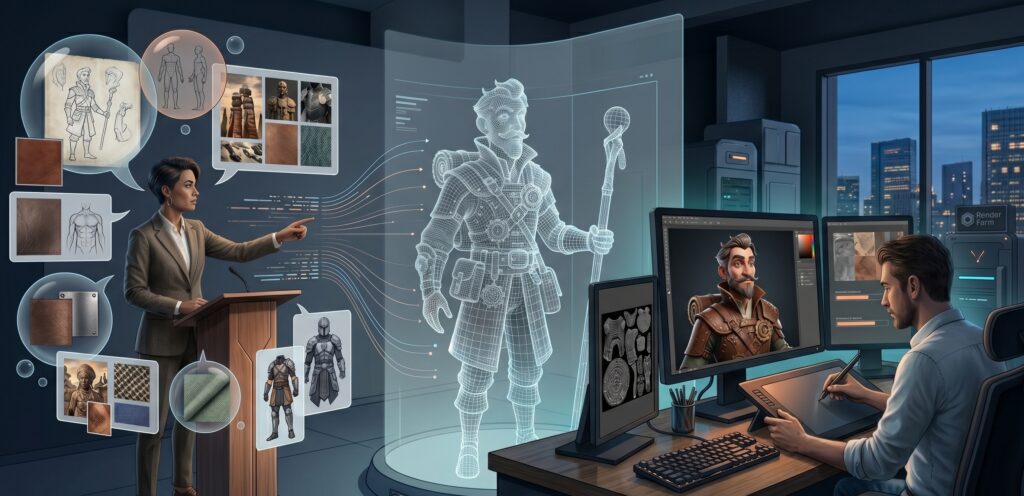
Once you've got your references in order, layer in your written description. Be intentional about what you focus on — physical traits, distinguishing features, costume and equipment, expression and demeanour, and a short backstory. You don't need to write a novel, but a paragraph of context gives the artist material that influences every micro-decision they make. A soldier who's seen too much holds themselves differently to one fresh out of training.
"A character is a message. What's yours saying? The answer to that question should be the first thing in your brief — not the last."
4. Know Your Technical Requirements Before You Brief
This is the section most clients skip — and it's the one that causes the most expensive problems. Before you send a brief, know the answers to these questions:
- What is the character for? A game, cinematic render, brand campaign, or virtual influencer — these are different deliverables.
- Which engine or platform? Unreal, Unity, mobile, console — each has different requirements.
- Do you need it rigged and animated? A static render and a fully rigged character have very different price tags.
- What file format do you need? FBX, OBJ, GLTF, USDZ — not all formats work in all pipelines.
- What texture resolution? 2K, 4K, 8K — knowing saves time, but if you don't know, say so.
Don't know your tech specs? That's fine — say so in the brief. A good studio will guide you through it. But walking in with even a rough idea shows you're serious and makes scoping faster for everyone.
5. Tell Us What You Don't Want
This is underrated and almost always missing from briefs. Knowing what to avoid is just as useful as knowing what to aim for. If there's a visual style you hate, a type of character that feels overdone, or a colour that conflicts with your brand — say it upfront. One clear "don't" can save three rounds of revisions.
- "Avoid anything that looks like a generic fantasy RPG — no plate armour."
- "Nothing too cartoonish or stylised — we want grounded realism."
- "No purple in the palette — it conflicts with our brand colours."
The revision trap: Most revision rounds aren't about fixing mistakes — they're about discovering things the client didn't know they disliked. A "what I don't want" section closes that gap before work even starts.
6. Be Clear About Timeline and Budget
Two things people avoid putting in briefs because they're afraid it will be used against them. It won't — it will actually help you. A realistic budget doesn't limit what you can get; it helps the studio scope the work correctly so you get the best possible result within your means. And a real deadline — not "ASAP" — lets the studio plan resources properly. If your timeline is tight, say so early. Don't mention it on day fourteen of a three-week project.
Get in touch with us
7. One Point of Contact. Please.
Nothing derails a character project faster than four people with different opinions all sending feedback separately and contradicting each other. Designate one person on your team as the decision-maker. They collect feedback, consolidate it into a single round of notes, and send it. One voice. One direction. Projects run on time when this happens. They run in circles when it doesn't.
The golden rule of feedback: One person in, one set of notes out. Every additional voice in the feedback chain doubles the revision time.
The Brief Checklist — Everything Your Artist Needs
One page. Eight sections. This is everything a professional 3D character studio needs to start a project confidently.
| Brief Element | What to Include | Status |
|---|---|---|
| Purpose | Why does this character exist? What role do they play? | Required |
| Audience | Who is this character for? Age, context, platform. | Required |
| Visual References | 10–15 images covering style, silhouette, costume, colour, mood. | Required |
| Written Description | Physical traits, costume, features, demeanour, short backstory. | Required |
| What You Don't Want | Styles, aesthetics, or elements to actively avoid. | Required |
| Technical Requirements | Platform, engine, file format, poly budget, texture res, rigging. | Required |
| Budget | A range is fine. It helps scope the work correctly. | Required |
| Timeline | A real delivery date — not "ASAP". | Required |
| Point of Contact | One person. One voice. One set of notes. | Strongly advised |
A good brief is the difference between a character that exceeds your expectations and one that goes through seven revision rounds before anyone is happy. It takes maybe an hour to put together properly. That hour saves weeks — and it sets the tone for the entire project relationship.
Kael Mercer
You’re paying for attention you’re not keeping. 105 Views South Africa has one of the highest small business failure rates on the …
Your ads aren’t broken. Your brand is. 110 Views Every week, somewhere on the internet, a business owner posts the same question …
3D Animation for Small Businesses Stop Losing Customers to the Scroll 1692 Views Your potential customer scrolls through 90 metres of content …
How to Brief a 3D Character Artist 824 Views Let’s be honest. Most creative briefs are terrible. Not because clients are bad …
Ready to start your project?
hambapixel.com · Studio & freelance 3D