Why AI-Generated 3D
Still Can't Match a
Human-Made Character

Every few weeks a founder or marketing lead lands in my inbox with the same question, phrased a dozen ways: "Can't we just generate the character with AI and skip the studio?" It's a fair thing to ask. The tools look magical in a demo. You type a prompt, a shape appears, and it feels like the whole problem just got cheaper.

I want to answer that honestly — not as someone protecting a craft, but as someone who has actually tried to build production pipelines around these tools and watched where they break. AI-generated 3D is genuinely useful. It's just useful for different things than most people assume, and mistaking one for the other is where the money quietly leaks out.

The one-line version

AI can generate a shape fast. It cannot generate a decision. A brand mascot is a hundred deliberate decisions about who this character is, how it moves, and how it survives across every platform you'll ever put it on — and that is exactly the part AI skips.

The core misunderstanding: a mesh is not a character

When people say "AI made a 3D model," what they usually mean is that a tool produced a mesh — a cloud of geometry roughly shaped like the thing they described. That's real, and honestly it's impressive. In our own pipeline we use mesh generation early on to block out silhouettes before moving into a proper sculpt-and-retopology workflow.

But a mesh is the raw block of marble. It is not the sculpture. A character your audience will actually recognise and trust needs clean topology, a face that emotes on cue, a body that rigs and animates without tearing, textures that read on both a billboard and a phone, and a design language consistent enough that people know it's your mascot the instant it appears. None of that is a shape. All of it is judgement.

What AI generation gives you

  • A fast first shape from a text or image prompt
  • Rough silhouette exploration in minutes
  • Messy, unpredictable topology under the surface
  • No rig, no reliable expressions, no motion
  • Output that looks generic because it's averaged from everything

What a human build gives you

  • A character designed to mean something specific to your brand
  • Clean topology that animates and deforms cleanly
  • A face built to hit exact emotional beats on cue
  • One asset that becomes video, stills, web and ads
  • A recognisable identity you own and can extend for years

The financial argument nobody runs properly

Here's where the "AI is cheaper" logic falls apart. People compare the wrong two numbers. They put the cost of generating a mesh next to the cost of a full studio build and conclude they've saved a fortune. But those aren't the same product, so it isn't a saving — it's a substitution of something incomplete for something finished.

The honest comparison is total cost to a usable, on-brand, animation-ready asset that you can deploy everywhere. When you measure that, the AI route often costs more, because you pay for it in the three places below.

The places hidden cost shows up: cleanup, rework, dilution
1Asset that should become video, blog, web and ads
0Recall value in a character that looks like everyone else's

Cost one: the cleanup you didn't budget for

An AI mesh arrives with topology no animator wants to touch — tangled geometry, no clean edge flow, no usable UVs. To make it move, someone has to retopologise it, rig it, and repaint it. That's skilled labour, and it doesn't get cheaper because the starting point was free. In plenty of cases it's faster to build clean from the start than to reverse-engineer a machine's guesswork. You didn't remove the expensive part of the pipeline. You just moved it downstream and added a repair bill.

💡

Rule of thumb: if a deliverable has to animate, hold up at billboard scale, or stay perfectly consistent across a campaign, the geometry underneath it matters. "Looks fine in a still render" and "survives production" are two very different bars.

Cost two: the rework loop

AI generation is non-directable in the way brand work demands. You can nudge a prompt, but you can't say "same character, now looking over her shoulder, mid-laugh, holding the product" and get the same character back reliably. Brand mascots live or die on consistency — the audience has to believe it's one continuous personality across every touchpoint. When each generation drifts, you burn hours regenerating and still don't converge. A human artist holds the character in their head and renders exactly the beat you need, first time, every time.

AI can give you a thousand characters. What a brand needs is the same one, a thousand times, without it ever wobbling.

Cost three: the dilution tax

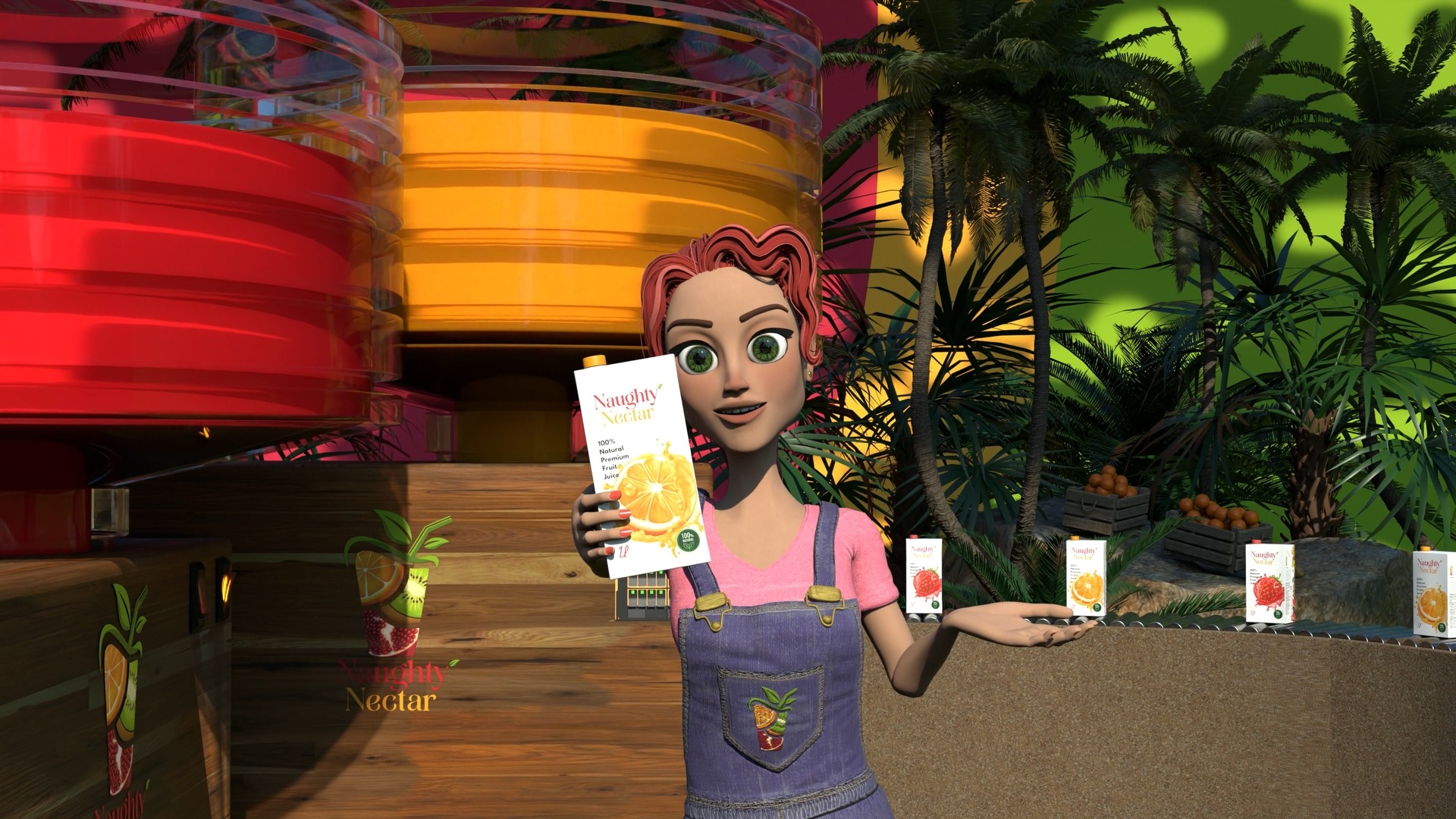
This is the expensive one, and it never shows up on an invoice. AI models are trained on the average of everything, so their default output looks like the average of everything. That's the opposite of what a brand is paying for. The entire point of a mascot is to be unmistakably yours. When we built Naughty Nectar's character and motion identity, the value wasn't the polygons — it was that the character carried the brand's specific attitude into every frame, so viewers connected the feeling straight back to the product. A generic, prompt-averaged character can't do that job. It shows up, it's competent, and it recalls nothing. You paid for an asset that quietly does no marketing work.
So where does AI actually earn its place?

I'm not anti-AI — I run it in my own pipeline. The point isn't "never touch it." The point is knowing which job it's good at, so you spend on the right thing. Here's the split I actually work to.

The jobAI generationHuman build
Early silhouette / idea explorationStrong — fast and cheapOverkill this early
Blocking a rough base meshUseful starting pointWhere the real sculpt begins
A mascot you'll animateNot production-readyEssential
Consistency across a campaignDrifts every generationLocked and repeatable
A recognisable, ownable brand identityAverages toward genericThe entire point
One asset → video, blog, web, adsCan't carry that farBuilt for exactly this

The real question to ask before you spend

Don't ask "can AI make this cheaper?" Ask "what does this character need to do for my business?" If the answer is get recognised, carry a personality, move on screen, and show up consistently everywhere for years — then you're not buying a mesh. You're buying a decision-maker who turns one build into a whole platform of brand assets. That's the maths that actually protects your budget.

Get in touch with us

Ready to build something unforgettable? Whether you have a fully fleshed-out brief or just a spark of an idea, we'd love to hear from you. Drop us a message and we'll get back to you within 24 hours.

Why AI-Generated 3D Still Can’t Match a Human-Made Character Every few weeks a founder or marketing lead lands in my inbox with …

Custom 3D Character: Make Your Website Impossible to Ignore. Your visitor decides whether to stay or leave in about the time it …

From Logo to Living Brand: How 3D Character Animation Is Replacing Static Identity There was a time when a well-designed logo, a …

You’re paying for attention you’re not keeping. 105  Views South Africa has one of the highest small business failure rates on the …

Ready to start your project?

hambapixel.com · Studio & freelance 3D

The idea doesn't have to be ready. You do.

Rough concepts welcome. We help shape the brief, scope the budget, and tell you honestly what’s possible. No pressure, no pitch.

Lets-Talk

Every project here started exactly like this.

Someone clicked. Typed something rough. We figured it out together. Your turn.

Egg

Still figuring out
your 3D brief

Join the monthly — we break down real projects so you don't have to start from scratch.

exit_intent_popup

Free Resource

The 3D Character Brief Checklist — every field your studio or freelancer needs before modelling starts. One page, free PDF.

Popup-60p
Let's hear it.

Fill in the basics — we'll take it from there.